











Watch & Learn
Parking Tickets in ParkSplain English. Bitesize tutorials.


We are a free educational platform that breaks down council and private parking enforcement, from signs, notices and appeals to tribunals and County Court proceedings.
Our bite-sized video tutorials, quizzes and interactive tools help you understand how the system works and what you might be up against.
What you're being accused of doing?
Steps you can take when you first get a ticket?
Learn the rules so you can comply, and check if they complied, they have rules too.
TE3, TE5, TE9, Northampton County Court — which forms do you use and when?
Your AI-assisted Parking Ticket Translator, helping you translate complex rules into plain English.
We don't tell you whether to pay or challenge your ticket.
We help you understand your options, and what you might be up against, so you can decide based on knowledge, not fear.


The Parking Ticket Checker is in development and is not yet available.

Discover the four principles of council parking — why tickets are issued and what they mean.

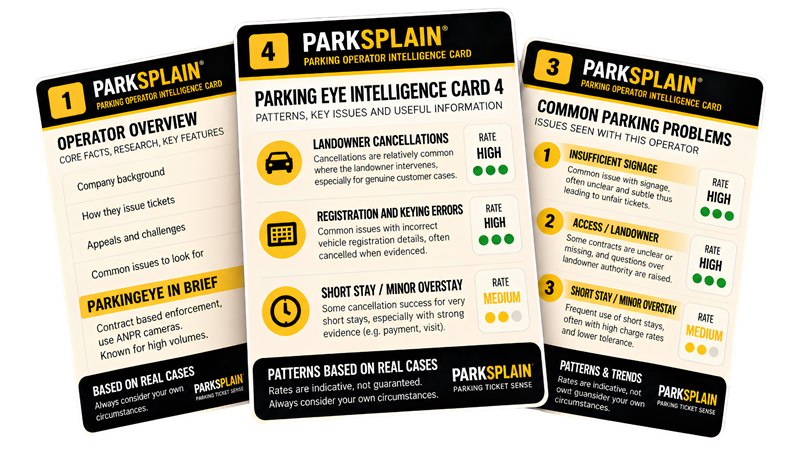
Who issued your ticket? Explore parking operators, their enforcement practices, what worked for other motorists — and what didn’t.

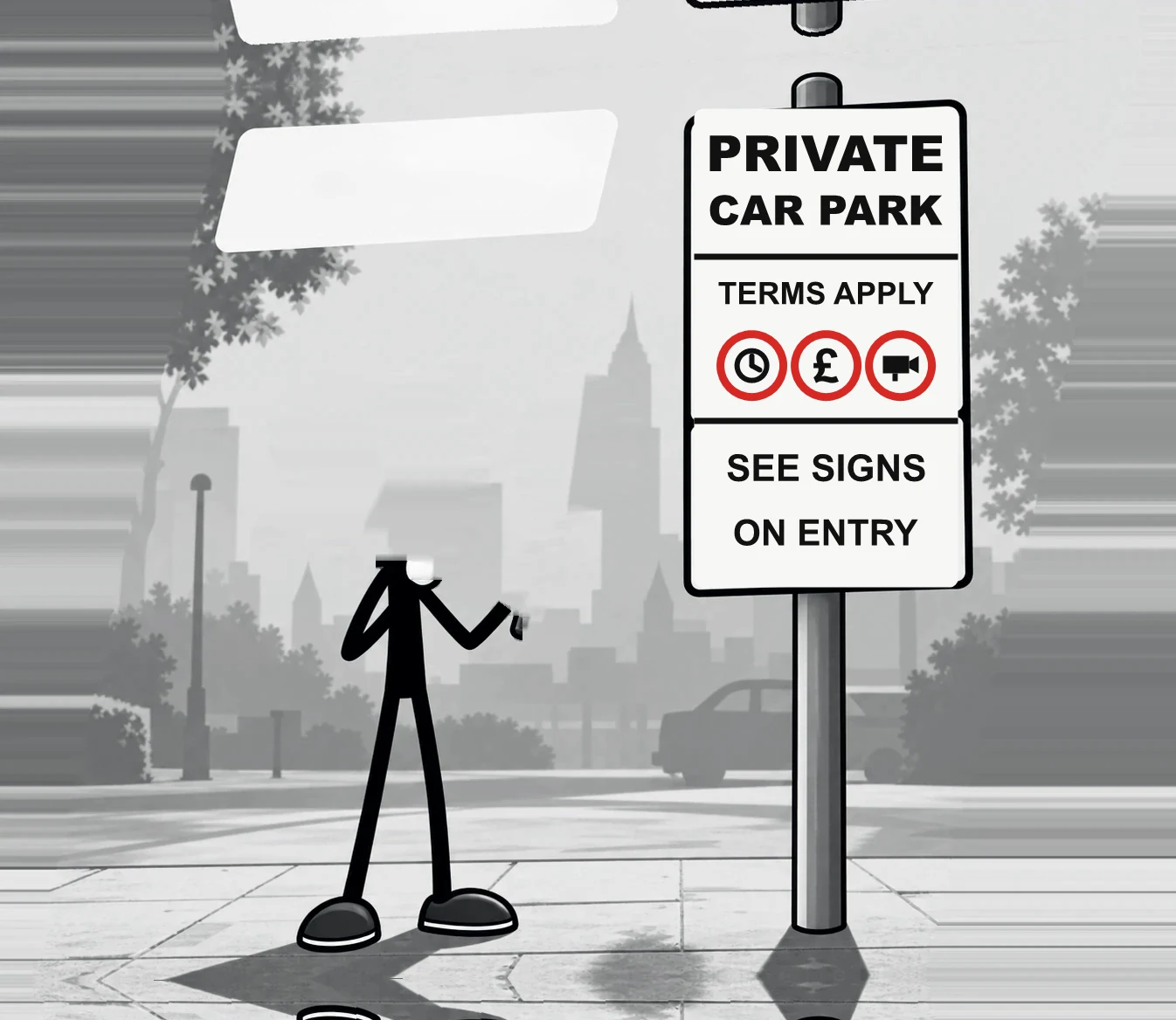
Discover the core principles of private parking — what they rely on and how they enforce them.
Wrong world?
Flip the switch
Learn the basics first
Hi, you've clicked on Council Signage.
So, this section matters to you.
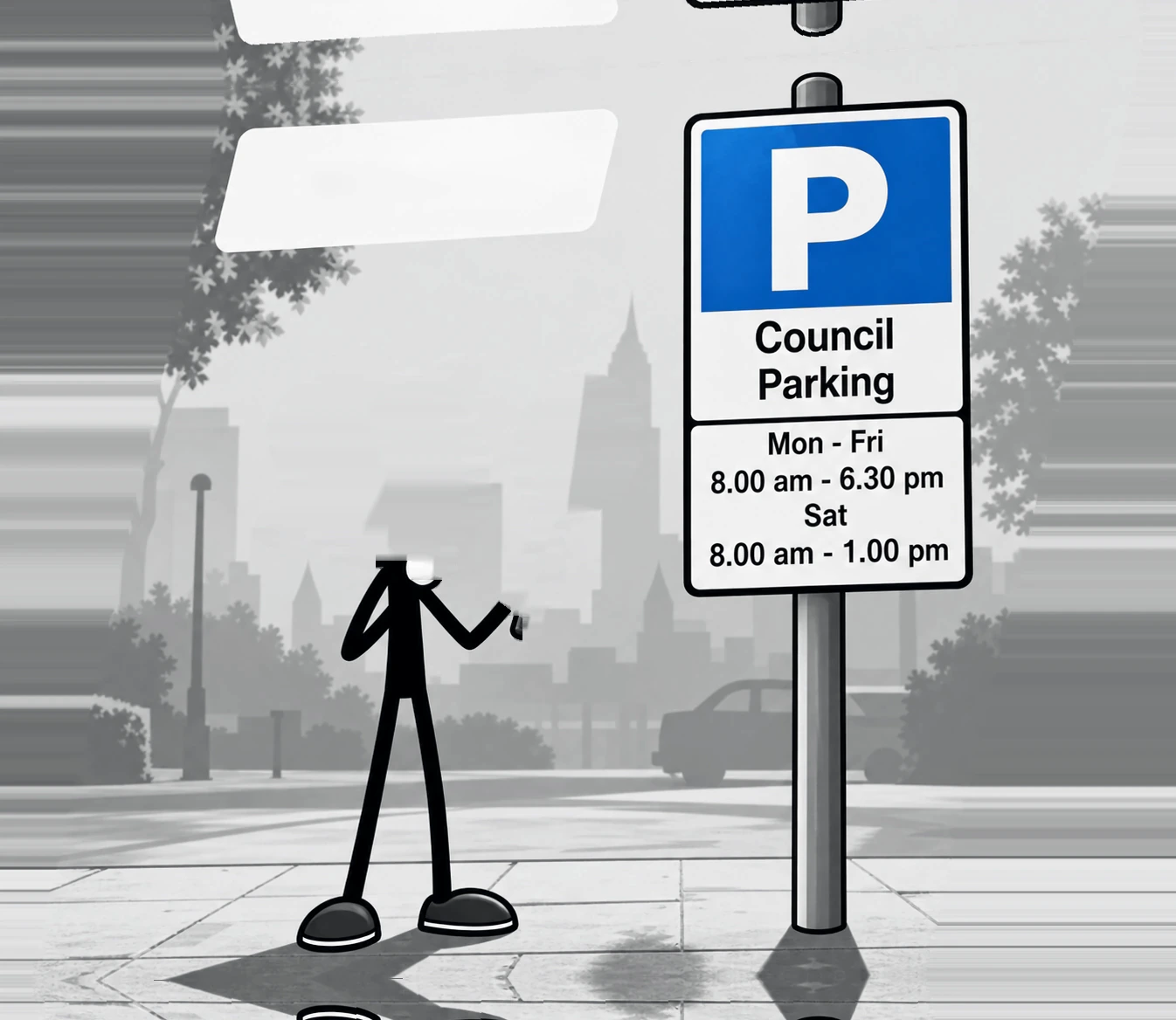
Council parking signs tell you where and when you can park, and what restrictions apply to the space you're in.
Many council parking restrictions come from Traffic Regulation Orders, or T-R-Os.
The signs and road markings communicate those restrictions to motorists.
Understanding the relationship between signs, road markings and your parking ticket, can make all the difference.
We're working to get this tutorial uploaded as soon as possible.
By the way, Private Parking Signage is live.
If you'd like to know when we upload Council Signage, leave your email address below.
We'll only contact you when this tutorial is published.
No newsletters, no marketing messages.
Just the notification you requested.
 Cameras
Coming Soon
Hi, you've clicked on Council Cameras.
So, this section matters to you.
Council cameras are used to monitor parking and traffic restrictions, and in some circumstances, the footage can be used to issue a Penalty Charge Notice, or P-C-N.
But councils can't simply use cameras to enforce every parking restriction.
There are rules about where and how camera enforcement can be used, and what the evidence needs to show.
We'll explain the role council CCTV cameras play in enforcement and how it relates to your parking ticket.
We're working to get this tutorial uploaded as soon as possible.
By the way, Private Signage is live.
If you would like to know when we upload Council Cameras, leave your email address below.
We'll only contact you when this tutorial is published.
No newsletters, no marketing messages.
Just the notification you requested.
Hi, you've clicked on Council Letters and Notices.
So, this section matters to you, when you receive a parking ticket from the council, that might not be the last letter you receive.
There are different notices issued at different stages of the enforcement process, and each one has a purpose, with its own deadlines and rules.
From the original Penalty Charge Notice, or P-C-N, to the Notice to Owner, Charge Certificate, and even an Order for Recovery.
Understanding what you've received and what stage you're at can make the difference.
Some cases are lost just based on the confusion of not understanding the order and what these letters and notices mean, when they're issued, and what you should do next.
This section is an important one.
We are working to get this tutorial uploaded as soon as possible.
By the way, Private Signage is live.
If you'd like to know when we upload Council Letters and Notices, leave your email address below.
We'll only contact you when this tutorial is published.
No newsletters, no marketing messages.
Just the notification you requested.
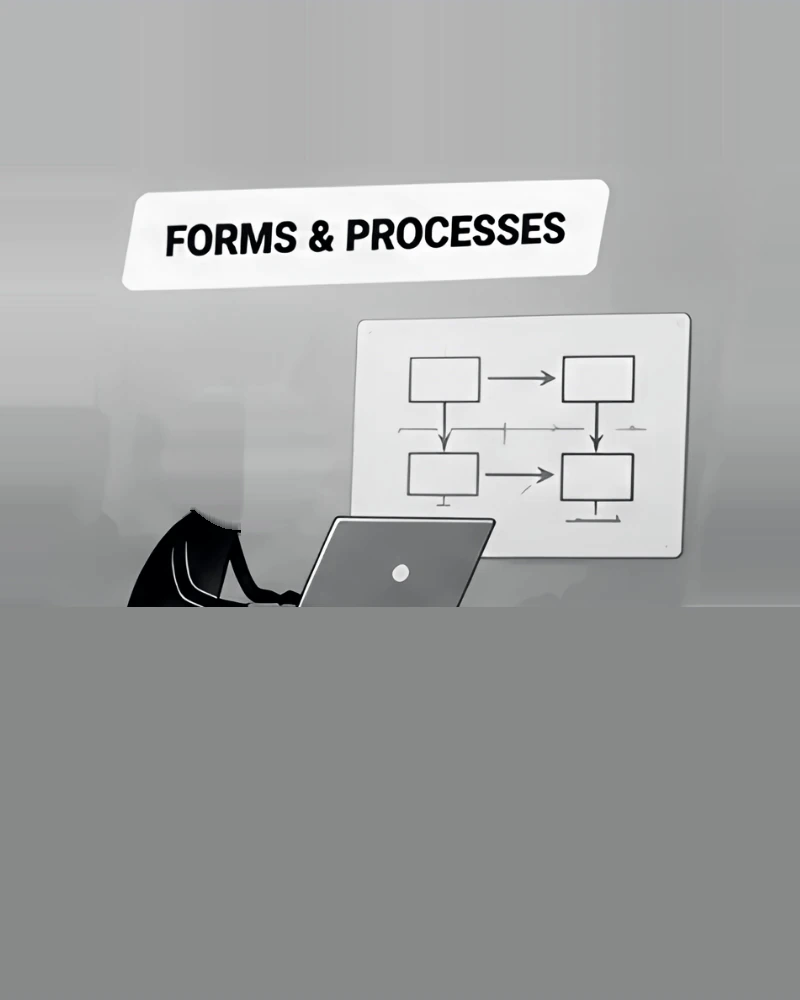
Hi, you've clicked on Council Forms and Processes.
So, this section matters to you, because challenging a council parking ticket isn't just about whether you think the ticket was issued correctly.
There's also a formal process to follow.
And that process matters.
Different forms are used at different stages. There are deadlines to meet, and the way you respond can affect what happens next.
From making an informal challenge or formal representation, to taking your case to an independent adjudicator, understanding the process can help you avoid mistakes that might lose you the opportunity to challenge.
We explain the purpose of the forms, when they are used, when they're needed, how the different stages work, and what options are available to you.
We're working to get this tutorial uploaded as soon as possible.
By the way, Private Signage is live.
If you'd like to know when we upload Council Forms and Processes, leave your email address below.
We'll only contact you when this tutorial is published.
No newsletters, no marketing messages.
Just the notification you requested.
Parking Tickets in ParkSplain English. Bitesize tutorials.
The parking enforcement conversation

Practical tools to help you act.
ANPR
Coming Soon
Hi, you've clicked on Private Cameras.
So, this section matters to you.
Private parking companies use cameras, in the form of A-N-P-R, to monitor vehicles entering and leaving their car parks.
These cameras record your vehicle registration number and the times you enter and leave.
But here's something worth understanding.
The time between entering and leaving a car park isn't necessarily the same as the time you've actually parked.
They don't show if you found a space or when, read the signs, paid for parking, or experienced a delay leaving.
But that won't stop them issuing you a ticket and counting the time from when you entered.
We explain how private parking cameras work, how it relates to you and your parking ticket 
By the way, Private Signage is live.
If you'd like to know when we upload Private Cameras, leave your email address below.
We'll only contact you when this tutorial is published.
No newsletters, no marketing messages.
Just the notification you requested.
Hi, you've clicked on Private Letters and Notices.
So, this section matters to you.
When you receive a parking ticket from a private parking company, that might not be the last letter you receive.
You could receive a Parking Charge Notice, a reminder, a debt collection letter, or even a Letter of Claim warning you about possible court proceedings.
We know big red letters makes you scared and that is the intention.
Not every letter has the same legal significance, and not every deadline means the same thing.
Some letters are requests for payment. Others are part of a formal legal process, and knowing the difference matters.
We'll explain the different letters and notices, what stage they represent, what the deadlines mean, 
We're working to get this tutorial uploaded as soon as possible.
By the way, Private Signage is live.
If you'd like to know when we upload Private Letters and Notices, leave your email address below.
We'll only contact you when this tutorial is published.
No newsletters, no marketing messages.
Hi, you've clicked on Private Forms and Processes.
So, this section matters to you.
Challenging a private parking ticket isn't just about whether you think the charge is fair or whether the parking company got something wrong.
There's also a process to follow.
And unlike council parking tickets, private parking charges operate under a different system.
There are deadlines, procedures and different requirements depending on the parking operator.
Council have TE forms for their court process, Private have N forms if you ever have parking tickets at the same time for both, that's not funny.
Understanding which stage you're at, which forms you might need and knowing which legal system your parking ticket falls under can make a real difference.
We'll explain how the different stages work, what the forms are used for.
We're working to get this tutorial uploaded as soon as possible.
By the way, Private Signage is live.
If you'd like to know when we upload Private Forms and Processes, leave your email address below.
We'll only contact you when this tutorial is uploaded.
No newsletters, no marketing messages.
Just the notification you requested.
Parking Tickets in ParkSplain English. Bitesize tutorials.
The parking enforcement conversation
Practical tools to help you act.
The parking enforcement conversation
Issue 1
The conversation behind the parking ticket.
In our first edition, we introduce ParkSplain — why it was created, what drives it, and what you can expect from Dispatch.
Case Reviews and how we can help you with your Parking Ticket.

Coming soon

Coming soon
Coming soon

Coming soon
FAQ video clip
Placeholder: the video goes here
Frequently Asked Questions
Council rules, private parking operators' rules and myths in between.
Here are 10 things that catch people out.
We just see them both as parking tickets and barely notice the difference. This question came top in the search bar of motorists' most frequently asked questions about parking tickets.
A council ticket is a Penalty Charge Notice, issued under statutory law.
A private ticket, on the other hand, is a Parking Charge Notice: a claim that you broke the terms of a contract.
Same initials, two different systems. Private charges aren't fines, even though they feel like one. But if they're valid, they can still be pursued through the courts.
Source: Council: Traffic Management Act 2004, Part 6. Private: contract law, with keeper liability under the Protection of Freedoms Act 2012, Schedule 4 (England and Wales).
Short answer: Yes, in paid or time-limited parking places. Not on yellow lines.
In England, council parking bays where you've paid, or where parking is time-limited, must allow 10 minutes after your time runs out. It doesn't apply on yellow lines, or anywhere you shouldn't have parked in the first place.
Private car parks covered by the industry's own Single Code (which means it's their code, not necessarily backed by law) already allow 10 minutes, but not every parking operator may have adhered, as some may have fallen under different, older industry codes.
The new government Private Parking Code makes 10 minutes the standard for every operator.
Source: Council: Civil Enforcement of Road Traffic Contraventions (Approved Devices, Charging Guidelines and General Provisions) (England) Regulations 2022, reg. 5(2); DfT statutory guidance. Private: Private Parking Code of Practice 2026, s. 5.2 and Explanatory Memorandum.
Short answer: Yes you can, but if you do you will get a ticket. Hazard lights are not a protection for breaching rules that are already in place.
Flashing hazards don't give you a few minutes on double yellows or in a restricted area. You can still be ticketed. If the restriction applies, hazards don't change it.
Source: The Highway Code, rule 116.
Short answer: No. In England and Wales it usually means up to 3 hours on yellow lines with the clock set, unless there's a loading ban.
In England and Wales, Blue Badge holders can usually park on single or double yellow lines for up to 3 hours, with the parking clock set to the time they arrived, unless there's a loading ban. The City of London, Westminster, Kensington and Chelsea, and part of Camden run their own schemes instead, so the national rules don't apply there in the same way.
Private car parks set their own terms, though NHS hospitals in England give free parking to Blue Badge holders attending as patients or visitors. A Blue Badge never allows parking that causes an obstruction or danger.
Source: Citizens Advice, Using your Blue Badge (England and Wales); DHSC, NHS car parking guidance 2022.
Short answer: Generally no. Once a council penalty charge is paid, the council closes the case. Challenges happen before payment.
Once you pay a council penalty charge, the case is closed. The formal challenge, first to the council and then to the independent tribunal, happens before payment, not after. If you're going to challenge, it has to happen before you pay.
If you paid under undue pressure, or the council didn't follow its own policies and the standards it should have, that matters. But it's a complaint, not an appeal: a separate route. (Look out for our videos, we'll put the link here when ready.)
Source: DfT statutory guidance, Civil enforcement of parking contraventions (a paid PCN: "the enforcement authority should promptly close the case").
Short answer: Not necessarily. Government guidance recommends councils re-offer it. Private rules vary by operator.
Council penalty charges are discounted by 50% if paid within 14 days (21 days for camera tickets sent by post). If you challenge within that window and the challenge is rejected, government guidance recommends councils re-offer the discount for a further 14 days. It's a recommendation, not a legal requirement, so check the rejection letter.
Private operators have their own rules for now, so check the notice. Once the new government code is in force, an appeal made within 28 days keeps the rate that applied when you appealed for a further 14 days after a rejection.
Source: England Regulations 2022 (as FAQ 2), reg. 2 and Schedule 3; DfT statutory guidance; Private Parking Code of Practice 2026, s. 8.1.2(e).
Short answer: No. Unless the signs say restrictions are lifted on bank holidays, parking restrictions still apply.
If a plate doesn't list any days, it applies every day, Sundays included.
Source: DfT, Know Your Traffic Signs: on-street parking control signs and road markings.
Short answer: Usually yes, unless yellow marks on the kerb show a loading ban.
Yellow lines don't automatically stop you loading or unloading. Short yellow marks on the kerb ("blips") mean there's a loading ban at the times shown on the nearby plate. Two blips mean no loading at any time.
Parking in a loading bay because you've got something in your hand, or to grab a coffee, isn't usually treated as loading. Tickets here tend to come down to three questions: was the bay used outside its restrictions or conditions; does your collection or load count as loading; and was any loading activity seen? How long an officer watches before issuing varies. No fixed observation time is set in national law.
Source: DfT, Know Your Traffic Signs: on-street parking control signs and road markings; DfT statutory guidance.
Short answer: You can, but it doesn't go away. In England and Wales an operator generally has six years to take it to court.
There's a rumour that a private parking ticket is just an invoice you can bin. I know plenty of people who've ignored theirs and never paid, and the parking company hasn't pursued them...yet.
A parking operator that stops chasing you is not a win. In England and Wales, they generally have six years to take you to court. They can come back around, and they do: 2 years, 3 years, 4 years, 5 years, 11 months and 30 days later. Or it can be passed to a debt collection company that pursues you instead.
How easy is it to defend a case five years later, when you can't remember the day or no longer have any paperwork? Rest assured; they will still have theirs.
Source: Limitation Act 1980, section 5 (England and Wales): "An action founded on simple contract shall not be brought after the expiration of six years from the date on which the cause of action accrued."
Short answer: Yes. In England, if the officer had started preparing the ticket before you drove away, the council can post it to the registered keeper.
In England, if an enforcement officer starts preparing a ticket and you drive off before it can be handed to you or put on the car, the council can send it to the registered keeper by post, generally within 28 days. Just watching the car isn't enough: the officer must have actually started preparing the ticket.
Source: England Regulations 2022 (as FAQ 2), reg. 10(2)(c), 10(4) and 10(6).
Educational information, not legal advice.
Practical parking products — prices visible upfront, no hidden costs.


Sorry, the video couldn’t load here. Open the video on its own
Sorry, the video couldn’t load here. Open the video on its own
Sorry, the video couldn’t load here. Open the video on its own